
Deliverable 4.2: Standard ML tasks
https://multispinai.eu/wp-content/uploads/2026/02/MultiSpin.AI-D4.2-Standard-ML-tasks_V1.0.pdf
List of scientific papers published
https://multispinai.eu/wp-content/uploads/2026/02/MultiSpin.AI-D4.2-Standard-ML-tasks_V1.0.pdf
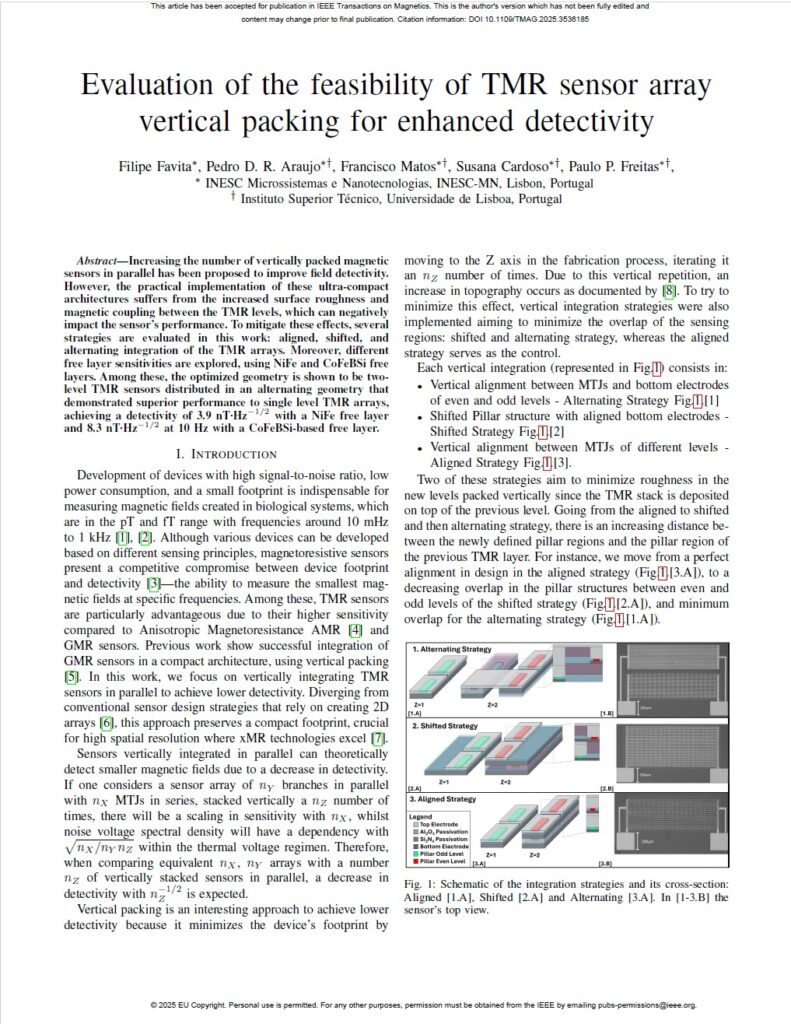
© 2025 IEEE. Personal use of this material is permitted. Permission from IEEE must be obtained for all other uses, in any current or future media, including reprinting/republishing this material for advertising or promotional purposes, creating new collective works, for resale or redistribution to servers or lists, or reuse of any copyrighted component of this work in other works. Authors: Cardoso de Freitas, SusanaInstituto de Engenharia de Sistemas e Computadores Microsistemas e Nanotecnologias https://multispinai.eu/wp-content/uploads/2025/02/IEEE-publication_Jan.-2025.pdf
https://multispinai.eu/wp-content/uploads/2025/02/MultiSpin.AI-D1.3_V1.0.pdf

Poster presented at MMM Intermag 2025Authors: Zaig, Ariel and Klein, Lior https://multispinai.eu/wp-content/uploads/2025/02/Poster_140_100_arielzaig_iSIM-25-1.pdf

Authors: Cardoso, Susana M; Kilinc, Necmettin; Erkovan, Mustafa https://multispinai.eu/wp-content/uploads/2025/02/nanomaterials-14-01098-with-cover.pdf
Presented at the The 16th Joint Conference on Magnetism and Magnetic Materials and Intermag by the project coordinator, Lior Klein (BIU) https://multispinai.eu/wp-content/uploads/2025/02/MultiSpin.AI-Talk_iSIM-25.pdf
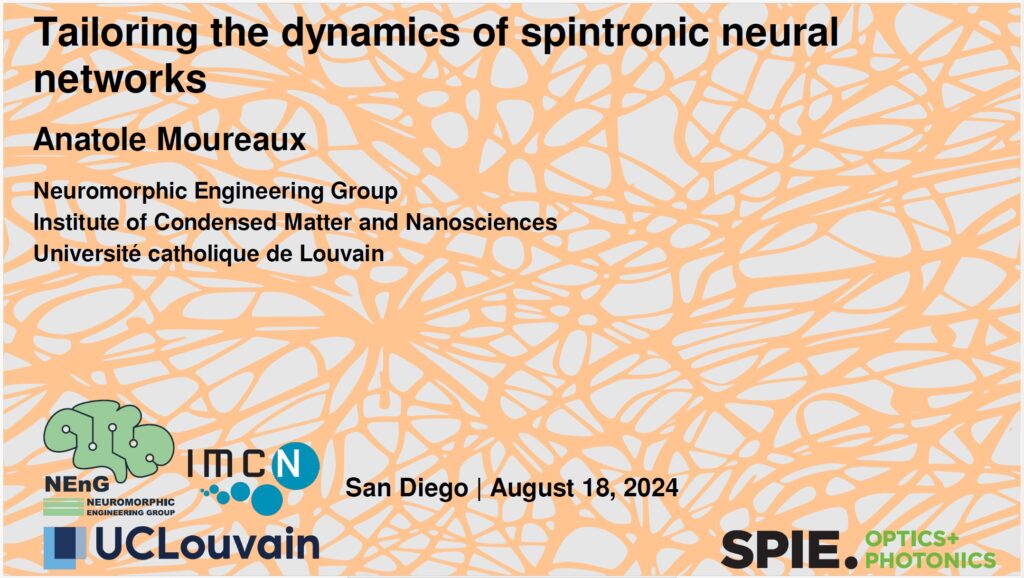
Nonlinear random projection machines are efficient neural networks capable of classifying real- life data with lower computational demands compared to standard artificial neural networks. They are well-suited for hardware implementation using nonlinear devices, enabling the creation of low-power hardware neural networks. We implement such a network using vortex-based spin-torque oscillators (STVOs), magnetic tunnel junctions (MTJs) that transform input signals nonlinearly at low power. We identify three physical parameters affecting the STVO dynamics and the network’s performance during data classification. We demonstrate their impact on a simplified nonlinear separation task and optimize them using ultrafast data-driven simulations for image recognition on the MNIST dataset. This approach holds potential for further hyperparameter optimization in STVO-based hardware random projection machines, and for the efficient development of custom neural architectures tailored for neuromorphic data classification Authors: Moureaux, Anatole ; de Wergifosse, Simon; Chopin, Chloe, Abreu Araujo, Flavio. Also available at Zenodo: https://zenodo.org/records/14811395 https://multispinai.eu/wp-content/uploads/2025/02/Moureaux_SPIE.pdf
The communication plan for the MultiSpin.AI project aims to ensure clear and consistent dissemination of information both internally and externally. Its main objective is to raise awareness and maximise the visibility of the project and its results while protecting its intellectual property.
This Data Management Plan (DMP) for the MultiSpin.AI project provides a framework for how data material will be handled during and after the end of the project. This document provides an overview of the datasets that will be collected, used and re-used within Multispin.AI. It is not a fixed document; it is a living document that will evolve during the lifespan of the project to include the research data that will be generated. It will therefore be supplemented during the interim and final reports.
To effectively communicate the vision, objectives, and progress of MultiSpin.AI, the creation of a graphical charter, logo, and comprehensive website was imperative. The deliverable 6.1 (website and project logo) encompasses these elements, serving as cohesive representations of the project’s identity and aspirations. It enables engagement with stakeholders, dissemination of research outcomes, and fosters collaboration within and beyond the scientific community.